
Oklahoma SOK Permit Practice Test 10
- Questions20
- Correct to pass15
- Passing score75%
- Minimum age15 years
-
1. Fog thickens until you can barely make out the vehicle ahead. What is the safest action?
Show answer
Answer A: Slow right down and, if needed, leave the road at a safe place
In heavy fog the only safe speed may be very low, and if it drops below what the road allows, the answer is to pull well clear of the traffic lanes.
-
2. An exit ramp is separated from the highway by a triangle of pavement painted with white stripes. What may you do there?
Show answer
Answer C: Nothing; keep off it and choose either the lane or the ramp
The striped area between a ramp and the through lanes is not for driving, stopping or last-second changes of direction.
-
3. Where is a U-turn most clearly unsafe and generally prohibited?
Show answer
Answer D: On a curve or near a hill crest, where other drivers cannot see you
U-turns are barred where approaching drivers cannot see you in time, such as on a curve or near the top of a hill.
-
4. You find that your shoulder belt has some slack in it. Why does that matter?
Show answer
Answer D: You travel further before the belt restrains you, so injuries are worse
Slack lets your body build up speed before the belt takes hold, which increases the forces on you and the risk of hitting the interior.
-
5. A sign at the approach to a bridge reads WEIGHT LIMIT 10 TONS. What does the figure set?
Show answer
Answer B: The heaviest vehicle the bridge may legally carry
A weight limit sign is a regulation based on what the structure can bear, and it applies to the loaded weight of the whole vehicle.
-
6. Driving at night you notice that the raised markers along the line beside you are throwing back red light. What does that tell you?
Show answer
Answer C: You are facing traffic and must get off that roadway
Red retroreflection is shown only toward traffic that should not be there, so a red return means the vehicle is heading the wrong way.
-
7. When should you enter a destination into a navigation device?
Show answer
Answer B: Before you start driving, or after parking in a safe place
Programming a route is a visual, manual and mental task at the same time, so it belongs to the moments before the vehicle moves rather than to any point in traffic.
-
8. You are turning left across tracks that run along the center of the street. What should you do before crossing them?
Show answer
Answer B: Look along the tracks in both directions and cross only when clear
Rail vehicles running in the street can arrive from either direction and cannot stop quickly, so look along the tracks before you turn across them.
-
9. You want to turn right at a steady red light and no sign prohibits the turn. What is required?
Show answer
Answer B: Come to a complete stop, then yield to traffic and pedestrians before turning
A right turn on a steady red is permitted only after a complete stop and only after yielding to cross traffic and to pedestrians, and a posted sign can prohibit it entirely.
-
10. You are traveling beside another vehicle on a multilane highway at nearly the same speed. Why is this a poor position?
Show answer
Answer B: You may be sitting in that driver's blind spot with nowhere to go if they move over
Driving alongside removes your side escape route and often puts you where the other driver cannot see you. Speed up or drop back to open space beside you.
-
11. You want to reverse direction but the street is too narrow for a U-turn. What is the alternative?
Show answer
Answer D: Make a three-point turn, or go around the block in heavy traffic
Where there is not enough width for a U-turn, the three-point turn does the job in stages, and on a busy street going around the block is safer still.
-
12. Why is standing water across a road dangerous even when it looks shallow?
Show answer
Answer B: It can hide a washed out roadbed, a deep hole or a missing cover
You cannot see the surface under the water, and floods commonly wash the roadbed away or lift covers off drains.
-
13. A police officer is directing traffic at an intersection and waves you through a red light. What should you do?
Show answer
Answer C: Follow the officer, whose directions come before signs and signals
Directions given by a police officer or an authorized flagger override signs, signals and pavement markings.
-
14. You are waiting in a center two-way left-turn lane. What should you expect from oncoming traffic?
Show answer
Answer A: Oncoming drivers may enter the same lane to prepare their own left turns
Both directions share a two-way left-turn lane, so an oncoming vehicle may be waiting in it and you must never treat it as yours alone.
-
15. This sign leads to a crossing that has no gates and no flashing lights. What does that mean for the driver?
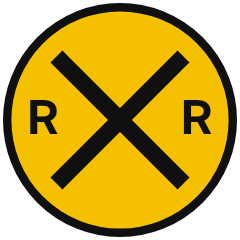
Show answer
Answer D: Nothing will warn of an approaching train, so the driver must check the tracks personally
At a passive crossing there is no active device to announce a train, so the whole judgment rests on the driver, who must approach slowly enough to stop after looking along the track.
-
16. An emergency vehicle is stopped on the shoulder ahead with its lights flashing. What does the move over principle require?
Show answer
Answer D: Change lanes away from it, or slow down if you cannot
Move over laws ask you to give responders an empty lane, and where traffic or a two-lane road makes that impossible, you slow down instead.
-
17. You notice a bulge on the sidewall of one of your tires. What should you do?
Show answer
Answer D: Have the tire replaced before driving far, because it could blow out
A sidewall bulge means the internal cords have broken and only the rubber is holding the air. The tire can fail suddenly at any speed.
-
18. Freeway traffic ahead of you has come to a stop. Besides braking early, how can you warn the drivers behind you?
Show answer
Answer B: By switching on the hazard lights for a few seconds
A short burst of hazard lights is a recognized way to tell following traffic that the queue ahead has stopped, and it carries much further back than brake lights. Some states restrict hazard lights on a moving vehicle, so use them only for the moment you are slowing.
-
19. You see smoke coming from under the hood while driving. What should you do?
Show answer
Answer D: Signal, pull well off the road, shut off the engine and move everyone away from the vehicle
Stopping and shutting off the engine cuts the fuel supply to a possible fire, and distance protects you if it spreads. Raising the hood can feed the fire a rush of air.
-
20. When should you turn on your signal before a turn or a lane change?
Show answer
Answer C: Well before the maneuver, so other drivers have time to react
A signal is a warning to others, so it has to be given far enough ahead of the maneuver that drivers and pedestrians can adjust.