
Oklahoma SOK Permit Practice Test 41
- Questions20
- Correct to pass15
- Passing score75%
- Minimum age15 years
-
1. You stop behind another vehicle at a traffic light. How much space should you leave?
Show answer
Answer D: Enough to see where its rear tires touch the pavement
Seeing the rear tires on the road leaves room to steer around the vehicle if it stalls, and gives a cushion if you are struck from behind.
-
2. What is the maximum jail term for a first offense DUI conviction in Oklahoma (BAC 0.08 or more), classified as a misdemeanor?
Show answer
Answer C: 1 year
A first offense DUI in Oklahoma is a misdemeanor punishable by not less than 10 days nor more than 1 year in jail, along with a fine of up to $1,000.
-
3. A sign reads END SCHOOL ZONE. What does it tell a driver?
Show answer
Answer A: The regular limit for that road applies again
An end of restriction sign marks the downstream limit of a special zone, after which the ordinary speed limit for that road governs again.
-
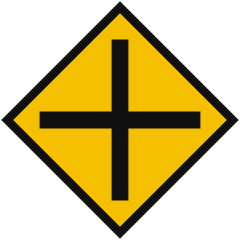
4. What should a driver expect a short distance beyond this sign?
Show answer
Answer C: Another road crossing the one being traveled
Traffic may enter or cross from either side at the intersection ahead, so the driver should ease off, cover the brake and check both approaches.
-
5. On a busy multilane highway, where is the best place to travel?
Show answer
Answer B: In a gap in the traffic, with space open on both sides
Travelling in a gap keeps escape routes open on both sides, while riding alongside other vehicles removes the room you would need to swerve.
-
6. Why should you not rest your foot on the brake pedal as you drive?
Show answer
Answer D: The brake lights stay on and the drivers behind cannot read you
Resting on the pedal keeps the brake lights lit and wears the brakes, so following drivers stop believing your brake lights.
-
7. Your left-turn lane shows a flashing yellow arrow. What does that indication allow?
Show answer
Answer B: A left turn after yielding to oncoming traffic and to pedestrians
A flashing yellow arrow marks a permissive left turn: the movement is allowed, but oncoming vehicles and pedestrians keep the right-of-way.
-
8. What does electronic stability control do that ordinary brakes cannot?
Show answer
Answer C: It brakes single wheels to bring the vehicle back on your intended path
The system compares where you have steered with where the vehicle is actually going, then brakes individual wheels to pull it back into line.
-
9. In plain words, what is understeer?
Show answer
Answer B: The vehicle keeps going straight even though the wheels are turned
Understeer means the front tires have run out of grip, so the vehicle takes a wider line than the one you steered.
-
10. What evaluation program is commonly required as a consequence of an Oklahoma alcohol-related driving arrest?
Show answer
Answer C: An Alcohol and Drug Substance Abuse Course (ADSAC) evaluation
An Alcohol and Drug Substance Abuse Course, known as ADSAC, evaluation is among the consequences commonly required after an Oklahoma alcohol-related arrest.
-
11. What makes up the total distance needed to bring a vehicle to a stop?
Show answer
Answer A: The distance covered while you perceive the hazard, the distance covered while you react, and the braking distance
Total stopping distance combines the ground covered while you notice the hazard, the ground covered while you move your foot to the brake, and the ground covered while the brakes slow the vehicle.
-
12. Small green signs with white numerals posted at regular intervals along a highway are used to
Show answer
Answer B: show distance along the route and give a reference point for reporting a location
Reference location signs, commonly called mileposts, carry white numerals on green and let a driver describe exactly where a breakdown or crash has occurred.
-
13. You and an opposing driver reach a four-way stop at the same time and both of you are turning right. What should happen?
Show answer
Answer C: Both may turn at the same time into their own lanes
Two opposing right turns take drivers into different lanes without crossing, so both can proceed together once pedestrians are clear.
-
14. What is the correct order of a pass on a two-lane road?
Show answer
Answer A: Check ahead and behind, signal left, move out, accelerate past, signal right and return
A pass begins with the decision that the road is clear and ends with a signaled return, and each step warns other drivers before the vehicle moves.
-
15. You are towing a trailer and turning right at an intersection. What must you allow for?
Show answer
Answer D: The trailer cuts the corner, so swing wider than usual
A trailer follows a shorter path than the towing vehicle, so its wheels track inside your line and can mount the curb unless you take the turn wide.
-
16. You are driving through patchy fog on a highway. What should you be ready for?
Show answer
Answer B: Sudden dense banks where visibility drops within a few car lengths
Patchy fog can go from clear to nearly blind in a moment, so keep your speed low enough that a sudden bank does not leave you without room.
-
17. The crossing gates begin to lower while your vehicle is still on the railroad tracks. What should you do?
Show answer
Answer B: Keep going forward and push through the gate if it should block your way
Gates are made to break away, and driving forward off the tracks is far safer than staying between them or backing up.
-
18. Why should you not switch the engine off while the vehicle is still moving fast?
Show answer
Answer B: You lose power steering and the steering may lock
With the engine off the steering becomes very heavy and on many vehicles the column can lock, so shift to neutral first and only shut down once stopped.
-
19. What is the safest way to handle an unrestrained pet or a child who needs attention while you are driving?
Show answer
Answer D: Secure pets before the trip and pull over safely before attending to a child
A loose animal or an urgent situation in the back seat can capture a driver's attention completely, so restrain pets beforehand and stop in a safe place when someone needs help.
-
20. On the Interstate system, what do the odd-numbered one and two digit routes have in common?
Show answer
Answer D: They run mainly north and south
Odd numbers are given to north and south Interstates and even numbers to east and west ones, with the numbers rising toward the north and the east.