
Oklahoma SOK Permit Practice Test 6
- Questions20
- Correct to pass15
- Passing score75%
- Minimum age15 years
-
1. A sign showing a walking figure inside a red circle with a diagonal slash stands at the start of a bridge. What does it mean?
Show answer
Answer C: People on foot may not use that roadway
The no pedestrians sign excludes people on foot from that roadway altogether, which is common on high-speed bridges and freeways.
-
2. You are behind three slow vehicles on a two-lane road and the way ahead looks clear. What is the sound decision?
Show answer
Answer D: Pass one vehicle at a time, if the road allows it
Passing several vehicles in one move keeps you in the oncoming lane far too long and leaves nowhere to go if a vehicle appears.
-
3. Why should you not leave the engine running when you walk away from your vehicle?
Show answer
Answer C: Because the vehicle can be stolen or can move on its own
An unattended running vehicle is an easy theft and, if the transmission slips or is knocked out of park, it can roll away with nobody at the wheel.
-
4. You want to turn right from a lane marked for through traffic and right turns, and the driver behind you wants to go straight. What should you do?
Show answer
Answer C: Signal, stay in the lane and make the turn when it is safe
A shared lane is the correct place to turn right from, so signal early and turn from the lane; the driver behind must wait or use another lane.
-
5. Why is parking against the flow of traffic dangerous even when nobody complains?
Show answer
Answer D: Because you had to cross traffic to get there and must cross again to leave
Parking on the wrong side means driving against traffic at both ends of the stop, and your reflectors and lights face the wrong way while you are there.
-
6. You are backing out of a driveway that crosses a public sidewalk. What should you do?
Show answer
Answer C: Stop before the sidewalk and check both ways
Walkers, runners and riders use the sidewalk at speeds that can bring them into your path in a second, so the stop and the look belong before the sidewalk, not after it.
-
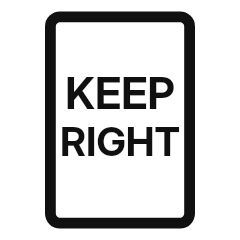
7. A driver ignores this sign and passes on the opposite side. What is the main risk?
Show answer
Answer B: Ending up on the wrong side of a divider, facing traffic coming the other way
The sign settles which side of a fixed divider is the legal one, so taking the other side sends the vehicle into the opposing stream or straight at the obstruction.
-
8. What is a marked loading zone for?
Show answer
Answer A: Loading and unloading only, not for general parking
A loading zone is reserved for actively loading or unloading goods or passengers; leaving a vehicle there for other reasons is a parking violation.
-
9. You are driving down a parking aisle and reach the main lane that runs along the front of the store. What is the usual rule?
Show answer
Answer C: The main through lane has the right of way over the vehicles leaving the aisles
In a parking lot the wide lane that runs across the ends of the aisles works like a through road, and drivers leaving an aisle yield to it.
-
10. You have turned right into the nearest lane but you need the left lane soon. When should you move over?
Show answer
Answer A: After the turn is finished, once you have checked mirrors and blind spot
Complete the turn in the proper lane first, then make a normal lane change with mirror and blind spot checks once you are established on the new street.
-
11. Why is hard braking the wrong response to a tire blowout at speed?
Show answer
Answer C: Because it can pull the vehicle further out of line and start it spinning
With one tire gone the braking forces are uneven, so heavy braking increases the pull to one side and can spin the vehicle.
-
12. An emergency vehicle with flashing lights and a siren is approaching from behind on a two-way street. What should you do?
Show answer
Answer C: Pull over to the right edge of the road and stop until it passes
Clearing a path by pulling to the right and stopping gives the emergency vehicle a predictable route, while stopping in mid-lane or inside an intersection blocks that path.
-
13. You leave a brightly lit service area onto a dark rural road. Why should you slow down for a while?
Show answer
Answer C: Your eyes need time to adjust, so at first you see less
Eyes take a few minutes to adapt from bright light to darkness, and during that time you can see much less than your headlights actually show.
-
14. What should you do before leaving a parked vehicle unattended?
Show answer
Answer C: Set the parking brake, place the transmission in park or in gear, switch off the engine and take the key
Securing the vehicle with the parking brake, the transmission and the ignition prevents it from rolling away and from being moved by someone else.
-
15. Your power steering fails while you are driving. What happens and what should you do?
Show answer
Answer B: Steering becomes much harder but still works, so slow down and pull off the road
Without power assistance the steering still works, but it takes much more effort, especially at low speed. Keep both hands on the wheel and get off the road.
-
16. You come to a place where a storm has dropped a power line across the road ahead. What should you do?
Show answer
Answer B: Stop well back, keep everyone away from it and report it to the police
A downed line may be live and can energize the ground around it, so keep well clear and let the utility or the police handle it.
-
17. The low sun is directly ahead and glare makes it hard to see. What should you do?
Show answer
Answer C: Slow down, use the sun visor or sunglasses, and increase following distance
Sun glare can hide pedestrians, brake lights and signals. Reducing speed and adding space gives you time to react to what you cannot yet see.
-
18. A sign at the intersection prohibits U-turns, but the opening looks wide and clear. What may you do?
Show answer
Answer B: Obey the sign and turn around somewhere else
A prohibition applies whatever the traffic looks like at that moment, usually because of sight distance or conflicts you cannot see from the lane.
-
19. You are the first to arrive at a crash on a rural road. What should you do first?
Show answer
Answer C: Park well clear of the scene, put on your hazard lights and call for help
Getting trained help on the way and keeping the scene visible does more good than anything an untrained bystander can do.
-
20. Your vehicle has antilock brakes. What should you never do in an emergency stop?
Show answer
Answer A: Pump the pedal up and down
The system already releases and reapplies the brakes many times a second. Pumping the pedal interrupts it and makes the stop longer.