
Oklahoma SOK Motorcycle Practice Test 39
- Questions20
- Correct to pass15
- Passing score75%
- Minimum age14 years
-
1. What extra limit applies in Oklahoma to a rider under 16 on a motorcycle or scooter of less than 150 cubic centimeters?
Show answer
Answer D: The rider may not exceed 35 mph and may not use a highway with a posted minimum speed
For machines under 150 cubic centimeters Oklahoma adds a 35 mph cap and bars the rider from highways that carry a posted minimum speed, such as interstates and turnpikes.
-
2. How can the vehicle ahead of you help you read the road at night?
Show answer
Answer A: Its headlights light the road further ahead than yours can reach
The lights of the vehicle ahead reach beyond your own beam, so its brake lights and the way it moves warn you about holes, turns and hazards you cannot yet see.
-
3. You are following a large truck on a two-lane road and cannot see past it. What should you do before deciding to pass?
Show answer
Answer D: Drop back so that your view of the road ahead opens up
Distance is what buys you a view around a large vehicle, and no decision to pass can be made from a position where you cannot see.
-
4. Why does a passenger often feel the cold sooner than the rider on a long ride?
Show answer
Answer B: A passenger sits still and does not have the fuel tank to shelter behind
The rider has a screen or a tank to break the wind and is busy operating the machine, while a passenger sits exposed and inactive and chills faster.
-
5. Which sequence describes a well-made turn?
Show answer
Answer A: Signal, move into the correct lane, slow down, check, then turn
Tell others first, take your position, lose the speed before the corner, take a final look, and only then steer through the turn.
-
6. A vehicle ahead of you displays a reflective orange triangle on its rear. What does that emblem tell you?
Show answer
Answer B: The vehicle is built to travel at 25 mph or less
The orange triangle is the slow moving vehicle emblem used on farm and construction equipment designed for 25 mph or less, warning you that you are closing on it much faster than it appears.
-
7. You see a shield for a three-digit Interstate whose first digit is even. What does that tell you about the route?
Show answer
Answer C: It loops around a city and rejoins its parent route
A three-digit Interstate beginning with an even digit is a loop or beltway that connects back to the main route at both ends, while an odd first digit marks a spur.
-
8. Your passenger wants to carry a bag in one hand during the ride. What should you tell them?
Show answer
Answer B: No, both hands are needed to hold on, so the bag must be secured on the machine
A passenger needs both hands on the operator or the handholds, and anything carried loose can be dropped into the wheel or pull the passenger off balance.
-
9. What limits how much weight a motorcycle can carry?
Show answer
Answer A: The load limit given by the manufacturer for that machine
The manufacturer's figure covers the rider, the passenger and everything carried, and going over it overloads the tires, the brakes and the suspension.
-
10. You are passing a crash on the other side of a divided highway. What should you do?
Show answer
Answer D: Keep your eyes on your own lane and the traffic around you
Staring at a crash scene, often called rubbernecking, causes sudden slowing and secondary collisions. Your attention belongs on the traffic in front of you.
-
11. Where do the greatest number of collisions involving motorcycles occur?
Show answer
Answer D: At intersections
Intersections concentrate crossing and turning paths, and the most common single event is a car turning left across the path of an oncoming motorcycle.
-
12. A yellow diamond shows an arrow bent into a series of reversing turns. What does it warn about?
Show answer
Answer A: Three or more changes of direction close together
The winding road sign replaces a string of separate curve signs where several bends follow one another with only short straights between them.
-
13. A steady green arrow pointing left is displayed for your turning lane. What does it tell you?
Show answer
Answer D: The turn is protected because conflicting traffic is being held
A steady green arrow gives a protected movement in the direction shown, although you still yield to pedestrians and to any vehicle already inside the intersection.
-
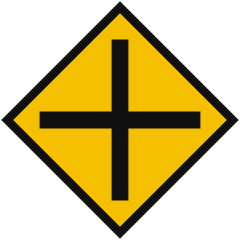
14. What should a driver expect a short distance beyond this sign?
Show answer
Answer C: Another road crossing the one being traveled
Traffic may enter or cross from either side at the intersection ahead, so the driver should ease off, cover the brake and check both approaches.
-
15. Rain has been falling steadily for half an hour. How does traction compare with the first minutes of the shower?
Show answer
Answer C: It usually improves somewhat, because the early oil film has washed away
Rain floats oil and dust to the top at first, so the road is most slippery in the early minutes, and a longer downpour rinses much of that film away. The pavement is still wet and grips less than when it is dry.
-
16. What protective gear should a passenger wear?
Show answer
Answer C: The same protective gear recommended for the operator
A passenger is exposed to the same crash forces, weather and road debris as the operator, so the same head, eye, hand, body and foot protection applies.
-
17. Permanent signs must be retroreflective or lighted so that
Show answer
Answer A: they show the same shape and color at night as by day
Retroreflective sheeting throws headlight light back to the driver, so a sign keeps its daytime shape and color after dark.
-
18. May you stop in the striped triangle that separates an exit ramp from the freeway lanes?
Show answer
Answer A: No, it is not a lane and stopping there is dangerous
The striped gore area is not a travel lane or a shoulder, and a vehicle stopped there sits directly in the path of drivers correcting a late exit.
-
19. At what distances must an Oklahoma driver dim high-beam headlights to low beams?
Show answer
Answer B: 1000 feet from an oncoming vehicle, or 600 feet from a vehicle being followed
Oklahoma requires dimming high beams to low beams within 1000 feet of an oncoming vehicle, or within 600 feet of a vehicle being followed.
-
20. Your right-turn lane shows a green arrow while the through lanes face a red ball. What does that mean?
Show answer
Answer C: Only the right turn is allowed, and it is protected while the arrow lasts
A green arrow gives a protected movement in that direction only; the red ball still stops the through traffic in the other lanes.