
Oklahoma SOK Motorcycle Practice Test 44
- Questions20
- Correct to pass15
- Passing score75%
- Minimum age14 years
-
1. You are about to pass another vehicle at night with your high beams on. What should you do?
Show answer
Answer C: Switch to low beams as you come up behind it and while you are alongside
High beams shining into the mirrors of the vehicle ahead blind the very driver whose reaction you depend on during the pass.
-
2. Why should a rider avoid riding through a puddle that spans the lane?
Show answer
Answer D: It can hide a deep hole or broken pavement under the surface
Standing water conceals what is underneath it, so treat a puddle as an unknown surface and go around it whenever you safely can.
-
3. How should following distance change when you ride at night?
Show answer
Answer D: Open it up to three seconds or more
Less light means hazards appear later, so a rider should slow down and stretch the following distance to three seconds or more.
-
4. Which of these places should never be used to turn your vehicle around?
Show answer
Answer C: The driveway of a fire station or the roadway in front of it
Turning around in or in front of a fire station driveway can block emergency vehicles leaving, and most states prohibit it.
-
5. You back into an unattended parked car in a lot and cause visible damage. What must you do?
Show answer
Answer A: Try to find the owner, or leave a note with your name and contact details, and report the crash
Hitting an unattended vehicle carries the same duties as any crash. Leaving without identifying yourself is a hit-and-run offense.
-
6. What is a rider looking for when inspecting the control cables?
Show answer
Answer A: Kinks, fraying and stiff or notchy movement
A frayed strand or a kinked outer will eventually jam or snap, which can leave a rider without a clutch, a throttle or a front brake.
-
7. How does becoming chilled affect a rider before any shivering is obvious?
Show answer
Answer D: It slows reactions and clouds judgment while the rider still feels fine
Cooling degrades reaction time and decision making before the rider notices it, so dress for the coldest part of the ride and stop to warm up rather than pressing on.
-
8. You are approaching the entry of a modern roundabout. Who must you yield to?
Show answer
Answer C: Traffic already circulating in the roundabout, which approaches from your left
Traffic in a United States roundabout circulates counterclockwise, so drivers entering must look left and yield to vehicles already in the circulating roadway.
-
9. An emergency vehicle with flashing lights and a siren is approaching from behind on a two-way street. What should you do?
Show answer
Answer C: Pull over to the right edge of the road and stop until it passes
Clearing a path by pulling to the right and stopping gives the emergency vehicle a predictable route, while stopping in mid-lane or inside an intersection blocks that path.
-
10. Under Oklahoma's Move Over Law, is the operator of a stationary emergency or maintenance vehicle excused from liability for reckless conduct?
Show answer
Answer B: No, the law still holds them responsible for reckless disregard of others' safety
Oklahoma's Move Over Law does not relieve the operator of a stationary authorized emergency, maintenance or wrecker vehicle from the consequences of reckless disregard for the safety of people and property on the highway.
-
11. A signal on an entrance ramp changes from red to green and lets one vehicle at a time onto the highway. What should you do?
Show answer
Answer A: Stop on the red and go on the green, one vehicle for each green
A ramp meter spaces vehicles out so they join the highway one at a time instead of arriving as a group, and it is a traffic signal like any other.
-
12. You are following a tractor-trailer so closely that its rear doors fill your windshield. What is the main problem?
Show answer
Answer D: You cannot see the road ahead and the truck driver cannot see you
A truck has a deep blind spot directly behind it, and tailgating also hides everything in front of the truck from you. Drop back so you can see and be seen.
-
13. A rider in the middle of the group pulls over onto the shoulder. What should the sweep rider do?
Show answer
Answer C: Stop and stay with that rider while the rest of the group continues
The sweep exists so that no rider is ever left alone at the roadside, while the remainder of the group carries on to a safe place to wait.
-
14. Beyond this sign, cones and temporary signs lead traffic along a path that does not agree with the lines painted on the pavement. Which one must the driver follow?
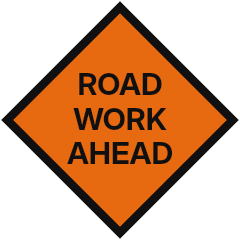
Show answer
Answer C: The temporary arrangement, because it replaces the permanent layout while the work lasts
Temporary traffic control set up for the work takes precedence over the permanent signs and markings, which no longer describe how the road is being used.
-
15. At a stop sign with a painted stop line and a crosswalk, where must you stop?
Show answer
Answer D: At the stop line, before it and before the crosswalk
You stop at the stop line first, and only if there is no stop line do you stop before the crosswalk, and only if there is neither do you stop before entering the intersection.
-
16. Your passenger keeps leaning out to one side to see the road ahead. What should you do?
Show answer
Answer B: Ask them to stay in line with you and look over your shoulder instead
Leaning out shifts the combined weight sideways and unsettles the machine, and a passenger can see far enough by looking past the rider's shoulder.
-
17. What is the benefit of looking far down the road rather than just ahead of the hood?
Show answer
Answer A: You steer with smaller corrections and you see trouble in plenty of time
A distant view steadies your steering and gives you time to plan, because you meet hazards after you have already seen them.
-
18. What should a rider look for in rain gear?
Show answer
Answer A: A riding rain suit that fits close and will not balloon or tear at speed
Rain gear designed for riding stays sealed and stays put in the airstream, while loose garments can flap, tear or interfere with the controls.
-
19. You are already inside an intersection when you realize you should be in the lane beside you. What should you do?
Show answer
Answer C: Stay in your lane through the intersection and change lanes afterwards
Drivers in an intersection are watching for cross traffic and turning vehicles, so an unexpected sideways move there is easily missed.
-
20. At a four-way stop another driver pulls out ahead of you when it was clearly your turn. What is the correct response?
Show answer
Answer B: Let that driver go through, then take your turn when the way is clear again
Right of way is something you give, never something you take, so yielding to a driver who takes it wrongly avoids a crash you would otherwise share.